

Newfoundland author shares story of hardship and recovery
By Olivia Bradbury, Local Journalism Initiative Reporter
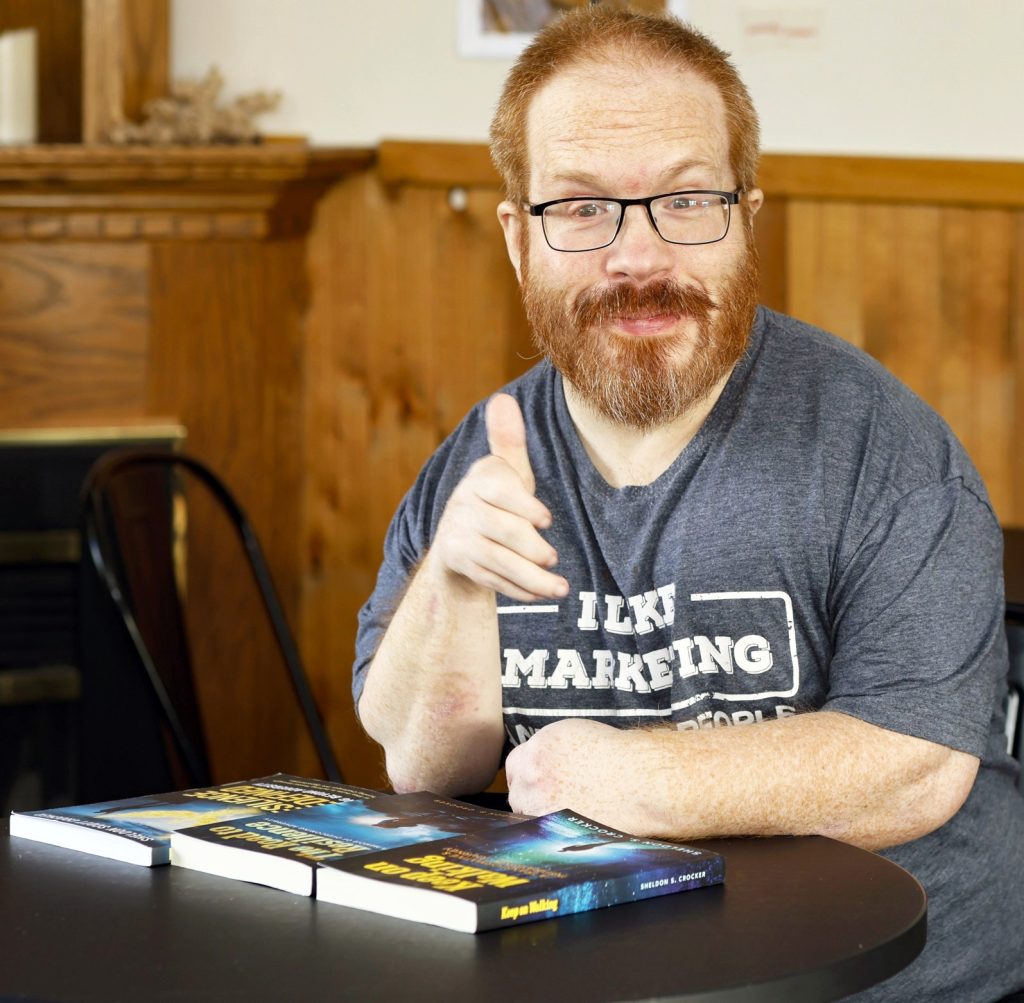
Sheldon S. Crocker of St. John’s has written a trilogy about his journey with disability, trauma, addiction, homelessness and, ultimately, recovery.
Crocker was born with arthrogryposis, a condition which affects muscular development and joint movement. For him, the effects were not just physical. He felt isolated within his community and was bullied by his peers.
“So when I talk about disability now, I try to talk about both sides of it,” said Crocker. “There is the physical side, yes, the movement, the limitations, the adaptations. But there is also the deeper human side, what it feels like to grow up being seen as different, and how that shapes your sense of self.”
An only child, Crocker lived in St. John’s until he was five, at which point his family moved to Chance Cove. Sadly, home was not a safe haven for him. Crocker said his mother beat him with belts and wooden sticks and his father was an alcoholic, who was verbally abusive.
“He said things to me that no child should ever hear, including that I would never be anything except a disabled welfare bum, and that he would have been better off if I had never been born,” said Crocker. “Those kinds of words do not just hurt in the moment. They settle inside you and follow you.”
In his earlier life, Crocker was also the victim of sexual abuse. However, when he told his parents what had happened, they refused to believe him. “That only deepened the hurt, because it taught me that, even when I did tell the truth, I might still be left alone with it,” he said.
Crocker said he started drinking by the time he was 11, and doing drugs by 13 — not for the sake of rebellion, but to escape the pain in his life.
“I have often described it as a love-hate relationship with substances, because that is what it became,” said Crocker. “It felt like comfort, but it was also destroying me.”
At 19, Crocker moved to Clarenville. His addiction got worse, and he experienced poverty and homelessness. All the struggles were connected to one another, he said; the addiction grew from the pain he already felt, and homelessness grew from addiction and the instability it caused.
“That is why I speak about these things the way I do now,” said Crocker. “I think people sometimes want to separate them neatly, but real life is usually not that tidy. In my life, it was one long struggle with many layers.”
Crocker said he struggled with addiction for about 16 years. “What really stands out to me is not only the number of years, but how much of my life disappeared inside them,” he said. “Some of that time is still such a blur. I have said before that although I lived in Clarenville for seven years, I remember, at most, six days clearly from that whole period. That says a lot about how lost I was. Addiction does not just take a person’s health or stability. It can take memory, time, identity, direction, and whole stretches of life.”
Crocker said many people do not realize homelessness is not just about a lack of shelter. “It is also about instability, shame, fear, and feeling like your life has completely come apart,” he said. “It is about not feeling grounded anywhere. It is about not really belonging anywhere. It is about surviving one day at a time while carrying a deep sense of failure and disconnection.”
Crocker said recovery came when his life got so dark he could no longer pretend he was managing it. He moved back to St. John’s at the age of 26, but his situation did not improve immediately. He was carrying a lot of trauma and mental health problems, and came very close to taking his own life. Eventually, however, things started looking up.
“One of the biggest turning points in my life was getting into Emmanuel House through Stella’s Circle,” said Crocker. “It was a four-month residential treatment program, and it changed my life. It gave me structure. It gave me a safe place to be. It gave me accountability. It gave me people who genuinely cared. That mattered more than I can properly put into words, because I was not used to steady care.”
After that, Crocker continued with Stella’s Circle’s Community Support Program, which made a huge difference and helped him rebuild. When he first quit drugs and alcohol, he told himself he would try it for a year; today, he has been sober for 25 years. Yet another turning point came when he let a doctor help him with his depression and anxiety.
It was during the pandemic that Crocker decided to start writing. One day, after realizing he had nearly walked to a liquor store after about 20 years of sobriety, he returned home and read his recovery journals. He recalled that people had told him he should write about what he had been through in his life. He finished his first book, Keep on Walking, quickly, and it was published two months later. Since then, he has added two more books to his Resilience Reborn series.
Crocker said he hopes to convey to his readers that pain does not have to have the final say about someone’s life, and that healing, while it can be slow and bumpy, is possible.
“To anybody who is struggling right now with trauma, disability, addiction, homelessness, anxiety, or depression, I would say this,” said Crocker. “Please do not let your worst season convince you that it is your whole life. I know pain can be very loud. I know shame can be very convincing. But there can still be life on the other side of what feels impossible.”
Crocker’s books, Keep on Walking, The Road to Resilience, and Resilience Redefined, can be purchased on Amazon, at Cole’s and Chapters in St. John’s, and at the gift shop at St. Clare’s Hospital. Crocker hosts a monthly book signing at the Jumping Bean on Topsail Road, where people can purchase copies directly.